

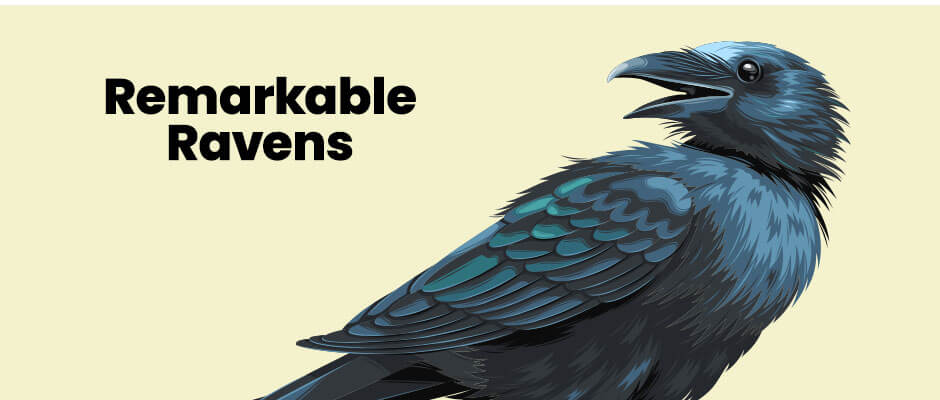
Since ancient times, the raven has been a symbol of death. This could be because it’s a carrion bird, feeding on the flesh of dead animals but there’s also something about the jet-black raven that makes it seem sinister, the sort of bird you might see in a Dracula movie perched eerily on top of the castle wall, looking all-knowing and devilish.
Larger than a crow, the raven is one of the few that taunts or mocks other creatures because it finds it funny – a bird with a sense of humour, albeit cruel. It has a harsh, deep, croaky voice and large strong beak. It avoids crowded areas and likes to fly upside-down, just for fun. Ravens are able to work in pairs, one distracting a dog’s attention while the other steals its food.
They can mimic the sounds of other birds and animals, even human voices. When hiding food from other ravens, a raven sometimes pretends to hide it in one spot, then deposits it elsewhere. However, other ravens are just as smart, so they can’t be easily deceived. There is evidence that ravens, perched on the roof of a supermarket in Canada, waited for people to pass so that they could push snow on them.
The best-known literature about the bird is Edgar Allen Poe’s 18-verse poem The Raven, about a raven who visits at midnight and answers every question with the word ‘Nevermore’. Most mythologies from around the world view ravens as powerful symbols and harbingers of bad news. Chinese, Egyptian, Greek, Semitic and Siberian legends depict the raven as a messenger of storms or bad weather, while in Africa, Asia and Europe, it forecasts death. The Roman orator Cicero was forewarned of his death by the fluttering of ravens. ‘To have a raven’s knowledge’ is an Irish proverb meaning to have a seer’s supernatural powers. In Sweden, ravens that croaked at night were believed to be the ghosts of murder victims.
A flock of ravens is called an unkindness of ravens, as well as a bazaar, a rant or a constable. The word raven comes from the German khraben, possibly an imitation of the harsh sound a raven makes. Surprisingly, the word ravenous ‘extremely hungry’ is not etymologically related to raven but comes instead from the Latin rapina ‘act of robbery’ which is exactly what the raven likes to do.
Happy Puzzling!

Recent Comments